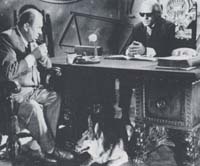
The 1000 Eyes of Dr. Mabuse
(Der Tausend Augen Des Dr Mabuse)
1961. German-French-Italian Co-production. Directed by Fritz Lang. With Dawn Addams, Peter Van Eyck, Wolfgang Preiss, Lupo Prezzo, Gert Frobe, Howard Vernon
"Find out what is going on at the Luxor!"
Members of my college film society used to quote this line with great glee. It was applicable to any occasion.You had to say it in the flat tones of a bad European dubbing job; one guy could even do it out-of-synch, moving his lips in a way unrelated to the sounds. In those days, when every fraternity boy could quote from Casablanca, we auteurists took pride in citing the benighted, essentially un-released Tausend Augen Des Dr Mabuse.
So what is going on at the Luxor? Fritz Lang's arch-villain Dr. Mabuse, killed off in a 1932 film, has reappeared. Still striving to take over the world, he has chosen the Luxor Hotel in Berlin as his base of operations. Back in the 30s, Dr. Mabuse had a network of spies providing him with information; in the 60s Mabuse uses hidden video cameras, two-way mirrors, and electronic eavesdropping devices. He's got the whole hotel wired, and he sits in his basement control center listening and watching ("like a spider at the center of his web," as someone said about the earlier Mabuse."). For most of the movie, Dr. Mabuse is an unseen presence; we don't get a look at his face, but we come to recognize his point of view. Whenever the events of the film turn out to be transpiring on a video monitor, we know we're looking over the shoulder of the omniscient Dr. Mabuse.
Lang does unusual things with his video-within-the-movie. We are watching the romantic leads involved in an intense scene. Then the camera pulls back to reveal that the whole scene is appearing on TV and that someone (unseen) in the foreground is fiddling with the controls. But we do not become involved in the framing scene, and never switch our focus to who is watching and why. Instead, the camera moves back toward the TV, the frame lines disappear, and we're back in the hotel room with Marion and Henry, still following their drama as though that visual diversion never happened. Throughout the film, the narrative keeps going through changes in the point of view from which it's seen: We may follow the story "straight" for a while, then see some of it via Dr. Mabuse's TVs, then through two-way mirrors, and back again. In effect, we appropriate some of Dr. Mabuse's powers. Like him, we are able to listen in on conversations that are supposed to be private and peek into rooms where we have no right to be.
On another occasion we see two characters enter an elevator. Pull back to reveal that it is actually a TV image of them entering the elevator. Pan to the adjacent monitor (Dr. Mabuse has a real video center down there), where we see the same characters leaving the elevator on a different floor and continuing their conversation there. Then a cut to another monitor gets us involved with another character in another part of the hotel; a sort of visual "Meanwhile..." The comparison to an editing room with its multiple Movieola screens offering different views is unavoidable.
Later it turns out that Dr. Mabuse is himself playing a number of roles, and has hypnotized various characters to play roles themselves, and has intervened in events we thought he was only observing. Finally we see him as the impressario par excellence—not just the master spectator, but the master director as well.
I don't want to claim any strict parallels between director Lang and the insane criminal Mabuse, who for Lang was always a symbol of Naziism and tyranny. But there are similarities. Mabuse derives his power from his control over photographic representations of people. Remote, anonymous, he sets dramas in motion and then watches them play out. Fritz Lang was, of course, a director of the dictatorial school; no spontaneity and improvisation on HIS sets. Throughout his career his editing and camera movements pinned his characters down. In this, his last film, he takes us behind the scenes, where we can do more than observe this top-down approach to artistic creation, we can experience it.
11/20/95
copyright ©2005 Barbara Bernstein
