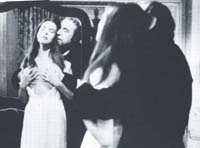
That Obscure Object of Desire
(Cet Obscur Objet du desir)
1977. Directed by Luis Bunuel. With Fernando Rey, Carole Bouquet, Angela Molina
The object of desire is a beautiful young Spanish woman named Conchita. Pursuing her, hopelessly enthralled, is portly, prosperous, middle-aged Parisian businessman Mathieu Fabert. Conchita remains not just obscure but maddeningly elusive—she takes money, flirts, promises, delivers up to a point, then pouts, recoils, and remains always a virgin. Conchita is often glimpsed behind counters, grillework, windows and other physical barriers. But even naked in bed next to Mathieu, she is unposessable. She says, "If I gave in you wouldn't love me any more."
Bunuel, bold and witty as ever, doesn't simply have his femme fatale behave in a capricious manner. He makes her capriciousness incarnate, by the simple trick of having her played by two different actresses. Without comment, without anyone inside the film seeming to notice, Conchita is sometimes embodied in the tall, impassive French actress Carole Bouquet, and other times by the shorter, rounder, more vivacious Angela Molina. When Mathieu encounters Conchita again after one of their separations, he recognizes her immediately even though she looks to us like a completely different person. As the film progresses, the alternation speeds up: One Conchita may leave the room for a moment and the other one come back in, dressed in the same outfit, continuing the same conversation. This is quite startling, for it's an axiom of fiction films that performer and character form a single entity for the duration of the film and (unless it's Alec Guiness doing one of his 8-role turns) don't diverge. So it becomes impossible to see Conchita as a character; she's something abstract, subjective: Mathieu's desire personified.
Or even more. There's a theory that the cinema itself works by enticing spectators with beautiful objects that they can never posess (and, I think, that this is turn mimics some low-level psychological pleasure that we take in viewing things that we cannot or do not wish to attain). Conchita may be talking about us too when she tells Mathieu that he'll lost interest in her once he "has" her. Robert Stam, who is a proponent of this "desiring spectator" theory that I have probably grossly caricatured, writes (in his 1985 book Reflexivity in Film and Literature, obviously a key text for members of this List), "Obscure Object is a protracted joke on the spectator, a narrative striptease that refuses to strip...The title's abstract promise of eroticism draws us to the theatre, but the film never delivers on the promise. Like Mathieu, we are cruelly locked out of the spectacle. . . Instead of stimulating desire, Bunuel holds the mirror to our own psychic fix on films themselves." I'm not sure about all of this: the film's title seems too intellectual to be really enticing, and if Bunuel doesn't show hard-core sex he at least reveals lots of breasts, at least by 1977 standards. But surely Stam is on to something: Who are we to be annoyed with Mathieu's continuing obsession with this frustrating woman, when we too--at a far greater remove from her than he is, being on the other side of the screen--so enjoy her (their) beauty and mystery.
That Obscure Object of Desire reminds me of the Dietrich/von Sternberg movie The Devil is a Woman, perhaps because there too the heroine is both Spanish and hard to get. (I think her name is also Conchita, but I might be wrong about that). In that case, Dietrich alone was able to accomplish what it takes two actresses to do here; her extremely artificial perfection and her famously flat affect keep us from trying to understand her "psychology" or from sympathizing too much with the man she is tormenting. She is there on display as an "object of desire," and we sense that the self-abasing suitor who is content merely to worship her from afar is standing in for us.
(10/23/96)
copyright ©2005 Barbara Bernstein
