A Matter of Life and Death
(Stairway to Heaven)
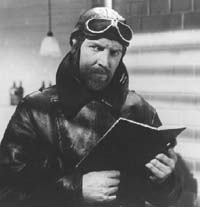
1946. The Archers. Directed by Michael Powell and Emeric Pressburger. With David Niven, Kim Hunter, Roger Livesey, Marius Goring
A beautiful new print of this famous/obscure movie is making the rounds (thanks largely to Martin Scorsese) and I hope that you'll see it if you have a chance. It's a surprisingly successful fantasy, so cheerfully idiosyncratic, so lovingly and imaginatively done, that it really does work a sort of magic. The story is an RAF version of the screwup-in-heaven story; in this case flier David Niven does not die when he's supposed to because his celestial "conductor" got lost in the fog, and now Niven has to be convinced to pass over voluntarily. The scene shifts between earth, where Niven has falled in love with a young American woman, and heaven, where the books don't balance, the rest of Niven's crew is waiting for him, and the luckless conductor is in all sorts of trouble.
The movie seems to have a number of agendas: solidarity among the Allies; comfort for the families of the war dead (there's a Coke machine in heaven); tribute to the home front; easing of post-war tensions between the US and the UK; and perhaps most important, reassurance after a horrible and chaotic decade that there is order and benevolence in the universe. It's charming, and quite a tour de force.
The movie is full of literary quotations, historical allusions, stylized performances, expressionistic sets, and some amazing process shots. Color, light and sound are used in non-naturalistic ways. This is an unabashedly cinematic movie, with all the stops pulled out. Freeze frames, tricks with the sound track, a sequence shot and scored to resemble a silent movie. The doctor character played by Roger Livesey has a camera obscura that projects a movie-like image in his study and lets him observe the townspeople going about their business like some benevolent god--or documentary film producer, which is what Powell and Pressburger had been.
Best of all, the scenes in heaven are shot in beautiful, sleek black & white, while the scenes on earth are in a lush, rather lurid color. The difference keeps us oriented as the scene shifts between the two realms, and it's a great way to make the afterlife seem somewhat abstract. But another result is to make heaven look like a movie. And since heaven is full of people dressed in the styles of different time periods, you sometimes think you're in the MGM cafeteria--Puritan and GI chatting with Louis XVI. What better way to suggest a fantasy-world heaven than to style it after the cinema, the ubiquitous fantasy-world of the 20th century.
The movie is not coy about this. After chipping away at the 4th wall, it punches right through in a scene where the foppish, bewigged conductor played by Marius Goring (as an aristocrat executed during the French Revolution) comes to earth to try to entreat the flier to report to heaven. We've only seen him in black & white up until now, and it's striking to see his powdered complexion, bright red lips, blue eye shadow. He materializes in the middle of a fabulously colored rhodedendron bush, plucks a pink blossom, and sighs, "Ah, one grows so starved for Technicolor up there."
This movie's wide embrace doesn't just include the whole of English literature and history, it reaches around and hugs itself as well.
(4/3/1995)
copyright ©2005 Barbara Bernstein
