The Man With a Movie Camera
(Chelovek s Kinoapparatom)
1929. Russian. Directed by Dziga Vertov. Photographed by Mikhail Kaufman. With Mikhail Kaufman and Elisaveta Svilova.
The Man With a Movie Camera has high-art credentials. It is a movie that in the 1960s might have been part of a museum exhibition on Soviet graphic design. The credits double asa manifesto (in exhortative Cyrillic) from director Dziga Vertov and his circle. They called themselves the Kinocks ("cinema eyes"). They believed that narrative cinema falsified reality and misled people (they particularly disliked "American adventure films"). They proposed instead an experimental "film without a scenario…without sets, without actors." The result is part urban documentary, part Constructivist experiment, and part reflexive delirium.
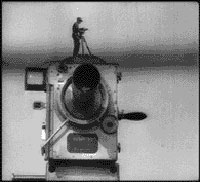
The prologue is set squarely in the avant-garde: we see a tiny cameraman superimposed atop a huge and heroically-lit movie camera. It seems more jokey collage than proletariat realism. The cameraman climbs down from the camera, walks into a movie theater and disappears into the screen. The chairs in the theater do a little dance via stop-motion photography. The projectionist threads up The Man With a Movie Camera. The show begins.
The movie proper follows the "symphony of a city" format, a kaleidoscopic rendering of urban life that was in vogue in the 1920s. Before dawn the city is still (the footage was shot in several different cities, actually), then life begins to stir: trams leave the barn, merchants hose off their sidewalks, people head to work, factories fill up, machines whir, telegraph wires hum. We return again and again to the geometries of trolley tracks and traffic signals. After work lets out there is cycling, soccer, puppet shows, the beach. A baby is born. A couple gets divorced. A funeral procession passes.
The Man With a Movie Camera does indeed document life in the worker's paradise immediately before the Depression. At the same time it documents the making of a movie, namely The Man With a Movie Camera. The Kinocks believed that cinema could be demystified if people could see how it was done. So (setting aside their disinterest in narrative), they take the cameraman we saw in the prologue as their hero and follow him as he shoots the very film we are watching. He arises before the city does (he is the first human we see) and sets out with his tripod over his shoulder. He appears throughout the movie, an intrepid explorer, filming from moving vehicles, climbing a tower with camera in tow, leaning out of a train window, perching on a parapet, going down into a mine, rushing to the site of an accident, etc. The film bills itself as "an excerpt from the diary of a cameraman."
One effect is to make the cameraman just another working man running a machine. But this is a curious kind of machine: what it produces is a record of both its environment and itself. Even more curious: the man running around with his tripod is in fact Mikhail Kaufman, the cinematographer of The Man With a Movie Camera (and Dziga Vertov's brother), in the process of making the movie that we are watching him in. The film does not shy away from this paradox, but embraces it.
In one pan shot aacross some store windows, Kaufman catches his own reflection. Usually, though, he "films himself" more obliquely: we see the footage he has shot intercut with footage of him shooting it (clearly there was another cameraman involved, poor uncredited schmuck.) Often we see the cameraman and his subject in the same shot and then switch to the cameraman's subjective view. In one curious sequence, Kaufman lies on the railroad tracks as a train approaches (perhaps a dig at American adventure films); after the train passes we see him retrieving a camera from a hole under the tracks. Only much later in the film are we shown the results: a train roars by just over our heads.
Montage gets deconstructed as thoroughly as photography. The editor of the film, Elisaveta Svilova, Vertov's wife and fellow Kinock, shows up half-way through to take charge of the images we have seen Kaufman capturing. In one stunning sequence, a laughing child suddenly freezes and there is a montage of frozen faces. A followup shot shows these shots as frames in strips of film; then a scissors appears and snip! Living people have been reduced to celluloid. They are simply a plastic material to be manipulated. Once Svilova has finished cutting and pasting, the people come to life again, their mobility restored.( It's a full half hour later that we see them in context, crowded around a clown in a park.) The movie we are watching includes its own assembly! When did Svilova edit the sequence showing her doing the editing? In another dimension?
There are many optical tricks, which Vertov would probably call legitimate "cinematic communication of visible events," but which I call self-referentiality. He uses multiple exposures, split screens, kaleidoscopic images. In one scene, towering camera tripods appear to tromp through the center of town like dinosaurs; in another a human eye (Vertov's own?) is superimposed on a camera lens. This all calls attention to the artificial, constructed nature of the enterprise.
The movie winds up with a real stunner. The audience in the Proletarian Film Theater is watching The Man With a Movie Camera (we know this because we've seen the projectionist open the labeled film can). Onscreen is Mikhail Kaufman riding a motorcycle with his camera on the handlebars, shooting directly into the camera that is taking the scene. So the audience is seeing Kaufman in the process of shooting the very film that he is appearing in, and they are appearing in the very film that they are watching.
The Man With a Movie Camera was unseeable for many years, and perhaps this is when Vertov got the reputation as a social-realist propagandist (the original American title was Living Russia). Clearly this is mistaken. The Man With a Movie Camera is extremely manipulative and unabashed about its contrivances. It recognizes that the process of recording, reordering, and juxtaposing creates profound instabilities and in the shock-art tradition of Constructivism and Vorticism, pushes those instabilities to extremes.
Is this a film-portrait of a city that comes clean about its own creation? Or is a film-portrait of artists creating a city for their own purposes? At first glance it seems that the man with the movie camera, cranking away, is recording the events before him, but maybe he is in fact driving them. Maybe his tirelessly-rotating arm is the dynamo that powers all those gears, pistons, sewing machines, trams, planes, typewriters, clocks, and carousels. The bustling city could be his dream, his cinema.
copyright ©2005 Barbara Bernstein
