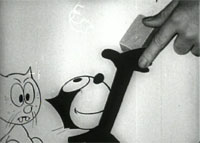
 Felix
borrows an eraser so he can
Felix
borrows an eraser so he can
pretty-up the girl
Comicalamities
1928. Sullivan Studios. Directed by Otto Messmer
Felix the Cat was the best drawn, most fully-realized cartoon star of the 1920s. He was also the most self-aware. Unlike Koko the Clown, Pete the Pup, or Gertie the Dinosaur, who could defy their animators only up to a point, Felix had complete control of his own plastic properties. When it suited his purposes, Felix felt free to treat himself as a drawn object—disassembling, transforming, manipulating his body. In Felix in Hollywood he turns into a cane and then a suitcase. In Pedigreedy, he wakes up in the morning and literally puts himself together, attaching first his ears, then his tail. In Comicalamities the animator forgets to ink him in, so Felix-in-outline seeks out a bootblack to get himself colored in and ready for action.
Felix's self-transformations do not reflect some kind of psychological effort made manifest; it's animation that is the subject here. Among Felix's powers is the one that created him in the first place: he can draw, and he can make his drawings come to life. Felix's versatile tail—always available as an accessory, weapon, or punctuation mark—can also turn into a pencil. If Felix needs to escape, he draws a circle on the ground and jumps into the "hole." If he doesn't like the looks of a fellow character, he redesigns her.
In Comicalamities, Felix has to rely on his own (human) animator for certain interventions. The human hand is the first thing we see; Felix is sketched, starts to move, and immediately starts arguing with his creator. (Unlike other cartoons, the hand is not really filmed; it's a cut-out still that moves around via stop-motion photography.) This human remains ready to help out: he lends Felix an eraser and pen, draws him a rope, and hides Felix from some angry sea creatures by pouring ink into the water. It's the animator's hand that plucks the fur off of a wooly creature so that Felix's girl can have a fur coat.
Yet Felix seems to be calling the shots. When the girl proves ungrateful, Felix rips her out of the scene and tears her into little pieces, leaving a gaping hole in the background. And in the most striking gag, the animator wants to end a scene before Felix is ready. As the iris closes in, Felix holds it back with his arms and, after a bit of wrestling, pushes the scene open again. Only when he has concluded his sad romance and disposed of the girl does he give the animator a "close it in" signal and let himself be irised into oblivion.
The Felix cartoons are terrific—full of personality, witty, avant-garde, self-conscious, and beautifully designed. There is an elegant use of white space, black shapes, and different line weights. The metaphysics of the Felix world are worth extensive study, and Donald Crafton's book Before Mickey provides a great place to start.
copyright ©2005 Barbara Bernstein
