Camera Buff (Amator)
1979. Polish. Directed by Krzysztof Kieslowski. With Jerzy Stuhr, Malgorzata Zabkowska, Ewa Pokas, Stefan Czyzewski.
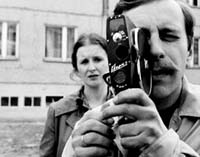
Filip Mosz, the camera buff of the title, is a Polish factory worker who celebrates his daughter's birth by buying an 8mm camera. He films the baby, as planned, and also his wife, his friends, his friends' cars, the view from his window, and sights around his neighborhood. Soon he is asked to record the 25th anniversary festivities at his factory. "The Anniversary" is such a success that the management lets him set up a sort of film lab/cineclub in the basement and proposes that he continue to chronicle the camaraderie and productivity at the factory. How this "amateur" (note the "love" in the term) becomes a serious filmmaker—both technically and philosophically—is story behind this accomplished political comedy.
Filip quickly becomes obsessed. He follows people around with that silly little camera up to his eye. He films his managers on their bathroom breaks. He films pigeons on the window ledge. When he intercuts the pigeon footage into his anniversary documentary, the factory manager is displeased but the dignitaries at a local Business Film Festival praise his "original viewpoint" and "gift of observation." He is accepted into Poland's small documentary film community and his films are shown on television.
Camera Buff, made as the Communist bloc headed into its final tailspin, is as much about politics as about filmmaking. We get a sense of the ineffectual bullying of the authorities and the quietly subversive perseverence of the artists. Filip faces a particularly eastern-European version of the filmmaker's struggle to attract resources but keep control. The workers' council at the factory continues to finance Filip's work, but it demands frequent re-edits and tries to suppress whole films. (The manager makes him start writing scripts so that they can be reviewed ahead of time.) While Kiezlowski is a great social observer, he is also a great humanist: there is not a single unsympathetic character is the movie
Early in the film, an older colleague tells Filip about how his brother found God. "No good came of it," the man warns. "He became a priest." But Filip is helpless in the face of his calling. He tries to explain it to his fed-up wife: though he loves his home and his job, "I realized that there could be something other than tranquility." She moves out, taking the baby he initially got the camera for.
Filip faces the questions that Kieslowski has clearly asked himself. Is life filmed more important than life lived? Do movies have more than utilitarian value? Do his exposes of waste and corruption really serve the common good? Is he exploiting his subjects or celebrating them? Is he capturing reality or manipulating it?
Eventually, the ambiguities
of the filmmaker's situation overwhelm Filip. He has helped many people
and inadvertently harmed others. His films have had consequences he never
intended. He makes a moral judgment to destroy one of his films and then,
instead of giving up filmmaking, rededicates himself to it. The wonderful
end of Camera Buff has Filip filming himself, actually holding
the camera out in front of him pointed at his own face, and telling the
story that we have just seen enacted-how his wife went into labor, how
his daughter was born, how he felt, what he intended. He has decided that
if he is going to strive for truth, he had better begin with myself. At
this moment, Kieslowski's fictional enterprise and Filip's documentary
one merge. The movie we have been watching neatly flips inside of itself
and starts over, on a new plane.
copyright ©2005 Barbara Bernstein
